
The Mechanical Sundial: Ancient Timekeeping Techniques Inspiring the Watchmakers of Today
- debentonjr
- Apr 30, 2025
- 3 min read
Updated: May 1, 2025
Recently, I found myself in an intriguing conversation with independent watchmaker Frederic Jouvenot, highlighting how the ancient timekeeping devices continue to fuel creativity in today’s horological scene. I was pleasantly surprised to receive a message from Jouvenot about the North American Sundial Society (NASS), as I usually reach out to watchmakers. Our chat about the NASS led us down an exciting horological journey centered around the Mechanical Sundial. Traditionally, the sundial is recognized as one of the earliest timekeeping tools, with the gnomon’s initial records dating back to around 3500 BCE. This device involved a vertical pillar, and its shadow’s length helped indicate the time. Jump ahead 5,525 years to 2025, and the sundial’s influence on horology persists. After exploring various museums in Greece in 2009, where mythology was vividly depicted, Frederic Jouvenot devised the concept for the Mechanical Sundial.
Jouvenot remarked, “an apparently simple idea came to me while contemplating the mythical god Helios: to succeed in integrating the design and functionality of the solar star in three dimensions into a mechanical watch dial.” At that juncture, he pioneered the first Mechanical Sundial, inspired by "the intimate play between light and darkness… thanks to a very complex and patented 24-hour jumping cage complication.” Describing this horological marvel, Jouvenot explained, “A hundred components are found inside the heart of the sun, a micro-technology prowess measuring 12 mm in diameter and 5 mm in height will activate the hour’s jumping beams.” This stunning creation in Haute Horology was nominated for the Grand Prix d’Horlogerie de Genève and has collected numerous Fine Watchmaking Awards. So what drives the unique Mechanical Sundial?
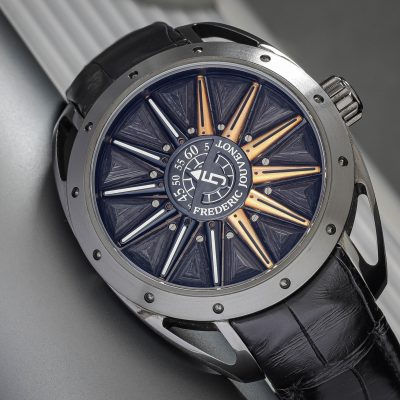
By Jouvenot’s account, the Mechanical Sundial is aptly named “Helios, in reference to the Greek tradition, the sun-shaped hour display is unique. It is the first hour display over 24 hours that shows the sun’s path and the alternation of night and day. Simple to read yet fitted with a complex mechanism, this piece in Frédéric Jouvenot’s Solar Deity collection has two faces, corresponding to the day and night cycles. For the first time in watchmaking history, a timepiece displays the time without conventional hands, numerals or disks (patented system mechanism).
Each hour is symbolized by a radiant sunbeam, originating from the center and radiating towards the dial’s edge. These twelve sunbeams illustrate the sun’s trajectory while showing the imminent hour and the previous one. Importantly, as the hours progress, the dial oscillates between light and dark. At midday, all sunbeams shine golden, signifying daylight, with the dial mirroring the sun at its zenith. As time rolls on, each ray turns black, in sequence and clockwise, gradually ushering in the night. Midnight showcases twelve dark beams mirroring the night’s essence. As daylight returns, the sunbeams pivot back to gold until midday, completing a full 24-hour cycle. Telling the time becomes instinctive. While traditional hour positions are maintained, a central cartouche with an index signifies minutes, orbiting a stationary minute disk.



HELIOS DISPLAYING TIME (FROM LEFT TO RIGHT) 00:00, 12:00, AND 21:00
The familiar angular spacing of the watch hands aids natural readability. For instance, at 3:30 p.m., three rays are black, with the minute indicator aligning at 6 o'clock. The typical angular relation between 3 o'clock and 30 minutes remains intact. It’s in this technical brilliance that Frédéric Jouvenot shines, preserving traditional reading styles amid an innovative hour display design.The Mechanical Sundial stands unparalleled, with no predecessor for comparison in terms of time-telling technique and historic inspiration. Jouvenot emphasized the scientific experimentation involved, stating, “Many philosophical reflections have been overcome to find technical solutions that can lead to a reliable physical reading result. To simplify the project equation, the solar star has twelve branches, one per hour, each positioned at 30° akin to a traditional watch face. This endeavor demanded tenacity, patent application, three years of honing, material research, and three prototype versions to perfect this significant technical and artistic achievement.”
While it isn’t a conventional sundial, its approach to showcasing time draws the wearer closer to the core of our solar system. Humans have long used the sun, moon, and stars to track time passage, and this timepiece pays tribute to the origins of timekeeping, enabling wearers to relish the sundial's beauty in a revolutionary manner.
You can visit Frederic Jouvenot's website at https://fjouvenot.com/
Comments